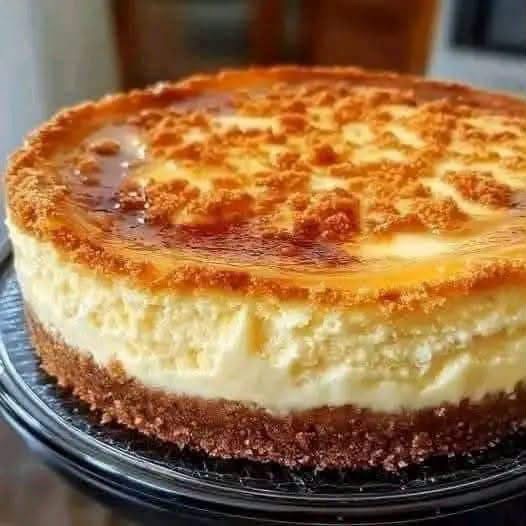
This gorgeous dessert features a thick, buttery Biscoff cookie crust, a velvety-smooth cream cheese and cookie butter filling, a mirror-like glossy Biscoff spread glaze, and a rustic border of crumbled spiced biscuits. Achieving this bakery-quality look and taste requires precision, patience, and full attention to temperature control.
Ingredients
1. The Biscoff Cookie Crust
- Biscoff or Speculoos Cookies: 250 grams (roughly 25 to 30 cookies), processed into fine crumbs. The iconic caramelized spice flavor profile is essential.
- Unsalted Butter: 100 grams, melted completely.
2. The Biscoff Cheesecake Filling
- Cream Cheese: 750 grams (three 8-ounce blocks or equivalent full-fat brick style), softened completely to room temperature. Avoid spreadable tub cream cheese, as the higher moisture content ruins the structure.
- Granulated White Sugar: 50 grams (1/4 cup).
- Light Brown Sugar: 100 grams (1/2 cup), packed. Brown sugar introduces deep molasses notes that enhance the caramelized flavor of the spread.
- Sour Cream or Greek Yogurt: 120 grams (1/2 cup), at room temperature. This adds a subtle tang that cuts through the richness and yields a silky mouthfeel.
- Biscoff Spread (Cookie Butter): 240 grams (1 cup), smooth variety.
- Pure Vanilla Extract: 1 tablespoon.
- Salt: 1/4 teaspoon to balance the intense sweetness.
- Large Eggs: 4 eggs, brought strictly to room temperature.
3. The Glaze and Decoration
- Biscoff Spread: 150 grams (approx. 1/2 cup plus 2 tablespoons) for the top mirror layer.
- Biscoff Cookies: 4 to 5 cookies, coarsely crushed for the outer rim.
Step-by-Step Instructions
Step 1: Preparing the Pan and Oven
Begin by adjusting your oven rack to the lower-middle position and preheating your oven to 160°C (325°F). Take a standard 8-inch or 9-inch springform pan and line the bottom circle with a sheet of parchment paper. Lock the outer ring into place, letting the excess parchment paper trap cleanly underneath. Wrap the exterior base and sides of the springform pan tightly with 3 to 4 layers of heavy-duty aluminum foil. This safeguard prevents water from seeping into your crust during the upcoming water bath.
Step 2: Crafting and Baking the Crust
Transfer your Biscoff cookies into a food processor. Pulse continuously until the cookies transform into a uniform, fine powder resembling coarse sand. Pour the crushed cookies into a medium mixing bowl, drizzle the melted unsalted butter directly over them, and stir thoroughly with a rubber spatula until every crumb is moistened and holds its shape when squeezed. Transfer the mixture into your prepared springform pan. Press the crumbs firmly down into an even, flat layer across the bottom, using the flat base of a measuring cup or glass to compact it. Push a small amount up the inner sides of the pan to create a sturdy rim. Place the pan into the preheated oven and bake the crust for 10 minutes. Once finished, remove it from the oven and set it aside on a wire rack to cool completely. Lightly grease the exposed upper interior sides of the springform ring with a neutral oil spray to ensure the filling releases cleanly later.
Step 3: Mixing the Silky Cheesecake Batter
In the bowl of a stand mixer fitted with the paddle attachment (or using a hand electric mixer), beat the softened cream cheese on medium speed for roughly 3 minutes until it is completely smooth, creamy, and free of any lumps. Scrape down the bottom and sides of the mixing bowl meticulously with a rubber spatula. Add both the granulated white sugar and the light brown sugar directly into the cream cheese. Beat on medium speed for an additional 2 minutes until the sugar crystals incorporate fully and the mixture lightens slightly in texture. Scrape down the bowl once more to ensure no pockets of sugar remain trapped at the bottom. Turn the mixer down to low speed and gently add the sour cream (or Greek yogurt), the 240 grams of Biscoff spread, the pure vanilla extract, and the salt. Mix just until combined, pausing to scrape the bowl down to guarantee a homogeneous batter.
Step 4: Incorporating the Eggs Correctly
With the mixer running on its lowest speed, introduce the room-temperature eggs one at a time. Wait until the first egg is completely integrated into the batter before dropping in the next. This slow sequence prevents the emulsion from breaking and stops excess air from whipping into the mixture. As soon as the final egg vanishes into the batter, turn off the mixer immediately. Do not over-mix, as trapping too much air will cause the cheesecake to swell excessively in the oven and collapse or crack upon cooling. Give the bowl a final manual fold with a spatula to pick up any unmixed streaks at the very bottom.
Step 5: Assembling the Water Bath
Bring a kettle of water to a rolling boil. Pour your rich Biscoff cheesecake batter directly over the cooled cookie crust inside the springform pan. Smooth out the top surface carefully using a small offset spatula. Tap the sides of the springform pan gently against your counter a few times to release any trapped air bubbles floating near the surface. Place your foil-wrapped springform pan inside a large, deep roasting pan. Set the roasting pan onto the oven rack, then carefully pour the boiling water into the outer roasting pan until it reaches about 3 cm (or roughly 1 inch) up the sides of the springform pan.
Step 6: Baking Low and Slow
Bake the cheesecake at 160°C (325°F) for 60 to 70 minutes. Avoid opening the oven door during the first 50 minutes, as sudden temperature drops can cause structural failure. The cheesecake is done when the outer edges look set, slightly puffed, and matte, while the exact center still maintains a gentle, soft jiggle when you give the pan a light nudge. Turn off the oven heat completely. Crack the oven door open slightly, wedging a wooden spoon handle in the gap, and leave the cheesecake inside to rest and cool gradually for 1 hour. This slow transition prevents thermal shock, which is the primary cause of unsightly surface cracks.
Step 7: Chilling and Setting
Remove the roasting pan from the oven, take the springform pan out of the water bath, and peel away the wet aluminum foil layers. Set the springform pan on a wire rack and let it come completely down to room temperature. Once cooled, cover the top loosely with plastic wrap—taking care not to let it touch the surface—and transfer the cheesecake to the refrigerator. Let it chill undisturbed for a minimum of 8 hours, or preferably overnight, to allow the starches and dairy fats to firm up into a dense, velvety texture.
Step 8: Glazing and Decorating
When you are ready to serve, run a thin knife warmed in hot water around the inner perimeter of the springform pan to loosen any clinging edges. Unlatch the side clamp of the springform pan and gently lift it away. Place the remaining cake on a sturdy serving stand. Take the remaining 150 grams of Biscoff spread and warm it gently in a microwave-safe bowl in short 15-second bursts, stirring in between, until it transforms into a smooth, fluid, pourable glaze. Pour the warm Biscoff spread directly onto the center of the chilled cheesecake. Use an offset spatula to guide the spread outward, pushing small amounts over the edge to create a uniform, glossy mirror finish. Finally, take your coarsely crushed Biscoff cookies and gently press them in a neat border around the outer perimeter of the top surface. Return the finished cake to the refrigerator for 20 minutes to let the topping set firmly before slicing with a clean, hot knife.